This year in July, I completed my first collaborative work of 2026 with Milouz (Tsf Crew), with whom I had previously collaborated on last year’s Stranger Things mural and on a mural in Mexico almost 14 years ago.
This first edition of the Mosbach graffiti festival featured around 40 artists from various parts of Europe, and the designated theme was: Homeland, which in Spanish translates to patria, tierra natal, or país de origen.
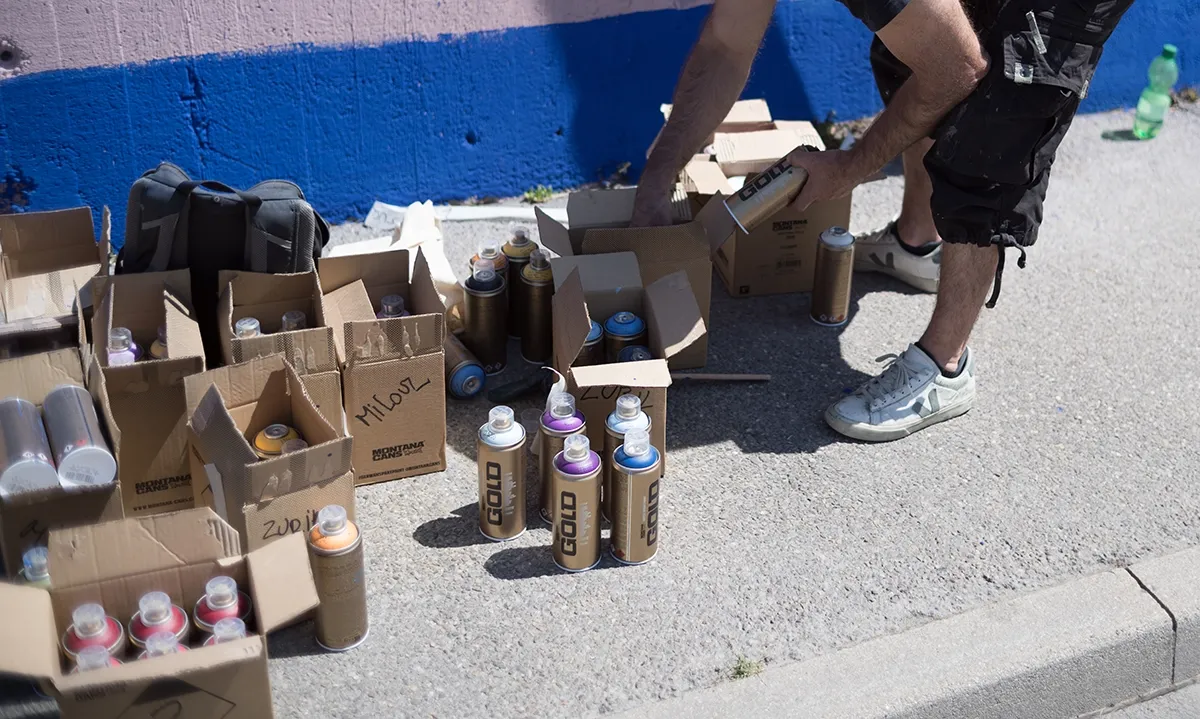
The first thing to consider is that we both have very different styles and processes. While Milouz comes from a long history of collaborative murals with his crew, accustomed to creating large scenes rich in perspective and detail, illustrations, and often improvising, giving himself more freedom to change ideas on the wall, I have had a solo career, where I control what happens from the drawing stage and where backgrounds tend to be much flatter and more graphic, with letters as protagonists that often guide the overall image composition. Reaching agreements requires knowing how to negotiate and finding that middle ground where we both felt comfortable with what we wanted to represent and how to do it. The festival defined a color palette and a limited amount of material per color, so we had to adjust our proposal considering these limitations.
So, what does it represent?
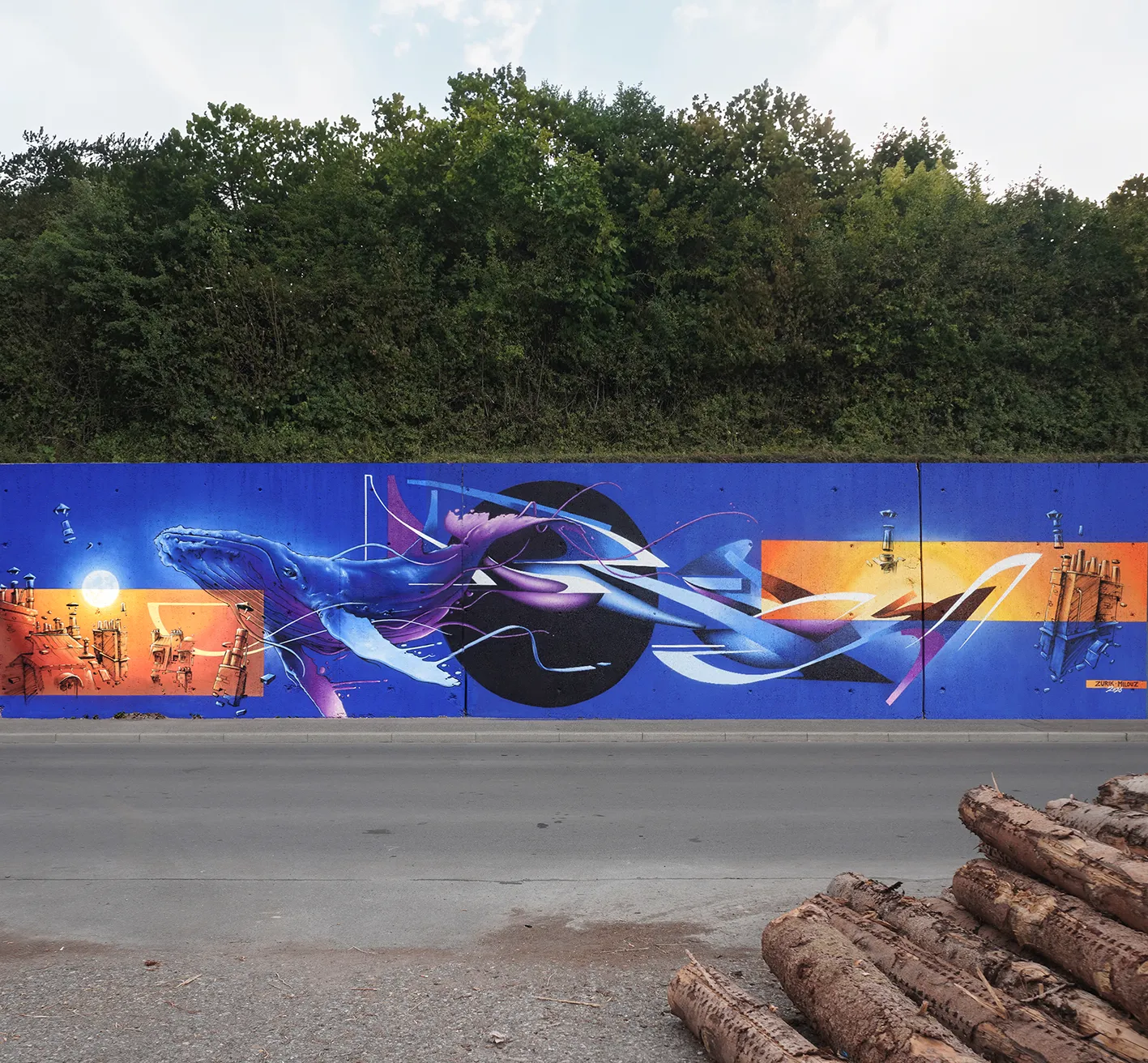
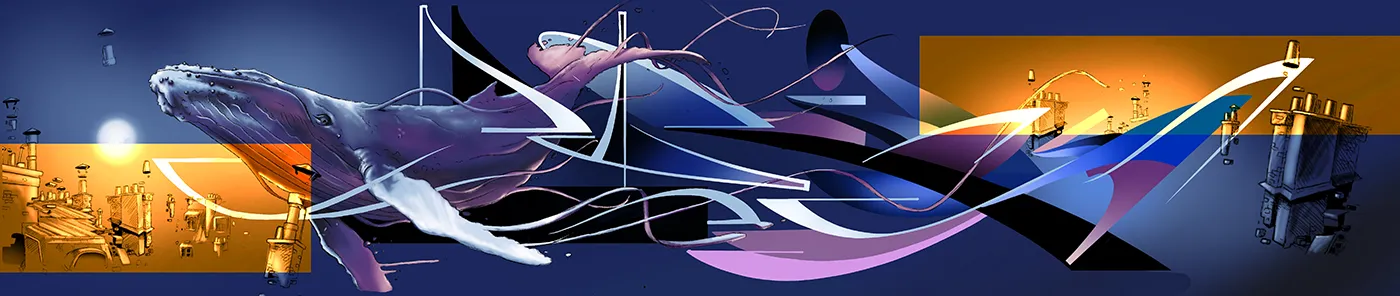
The scene shows a whale soaring over the rooftops of Paris, a city that has become one of our reference points and part of our home. It is a dreamlike representation of the migratory journey this species undertakes each year, traveling thousands of kilometers to complete its biological cycle, always returning home at the end of each one to start anew. That is why the rooftops, both at the beginning and at the end of the mural, always represent the same place. In a variation of that idea, the rooftops on one side would be Bogotá / Barcelona and the others Paris, but we would lose the idea of the cycle, making the whale only move from point A to point B.
What was the drawing process like?
As my letters can adapt more freely, Milouz defined the central figure in line art, and from there we exchanged the sketch to add and test options not only with the letters but also with the floating chimneys. You can see that my Z is practically just outline lines that cross the whale; this was a compositional decision we made to avoid adding visual weight to the whale by placing solid surfaces above and below; we both agreed that we wanted the whale to “float” in space, something somewhat complicated given so much horizontal space and so little height, which is why we eliminated anything that could visually anchor it to the ground.
The orange stripes that change the scene’s color were my contribution to the background; it’s something I often use in different ways in my work. The illustrations of the chimneys were his, as black line drawings with small touches of light are a recurring element in his work.
What is the difference between doing an individual wall and a collaborative one? What are the challenges and the positive aspects?
ZuriK: Without a doubt, the challenge is learning to let go of the structure each person has when composing; when you have worked for a long time in a personal style, stepping out of that comfort zone is difficult and it’s hard to adapt to changes because we have predefined what works and what doesn’t within that structure. One of the positive aspects is the shared brainstorming. Many times we have an idea and when we draw it, we see it instantly, but someone else might not and feel confused about what we are trying to represent; this in itself is not bad, in fact, pictorial works are open to interpretation and exposed to the viewer’s reading, but having another pair of eyes that delves deeper, asks questions, and contributes to building a better project is enriching. On the other hand, it’s not easy to decide who to collaborate with; here, the criteria and trajectory of each person also come into play, as well as the degree of respect, trust, and admiration between both parties.
Milouz: Personally, I prefer collaborative walls. Creating an individual wall provides, in a sense, a form of creative freedom, but it requires comprehensive work in the composition; therefore, one has to fill the space alone, confront oneself, and thus also face doubts alone and answer them to create a whole that suits us.
As for the collaborative wall, although composing with others can sometimes be complicated, it is precisely there that one can push their limits, make concessions and compromises, and that is how, for me, creativity is revealed. As a reward, these types of works can lead to truly original creations. Furthermore, mural painting is a way of sharing with the people who will contemplate that wall, and if, at the same time, I can share with those who create it, that makes the process even more complete.
If you could change anything, what would it be?
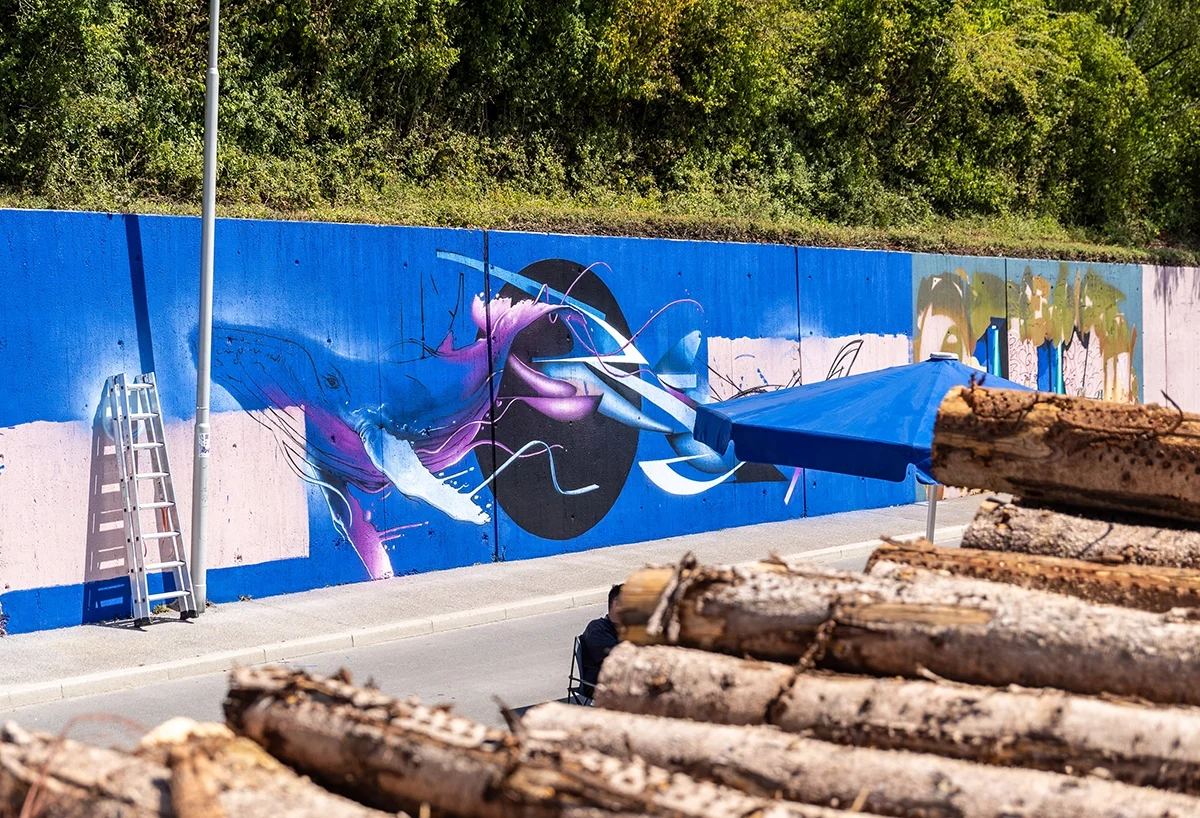
Zurik: I would like to lower the saturation and darken the blue of the background, as well as add more illustrations to the background. The last thing we wanted was for it to look like the whale was in the sea, and I’m afraid that’s what most people perceive.
Milouz: Perhaps with more material, I would have liked to create broader gradients in the background to accentuate the light and depth effects. But once the mural was completed with the provided material, the assigned time, and the conditions at the time, I believe it turned out exactly as it should.
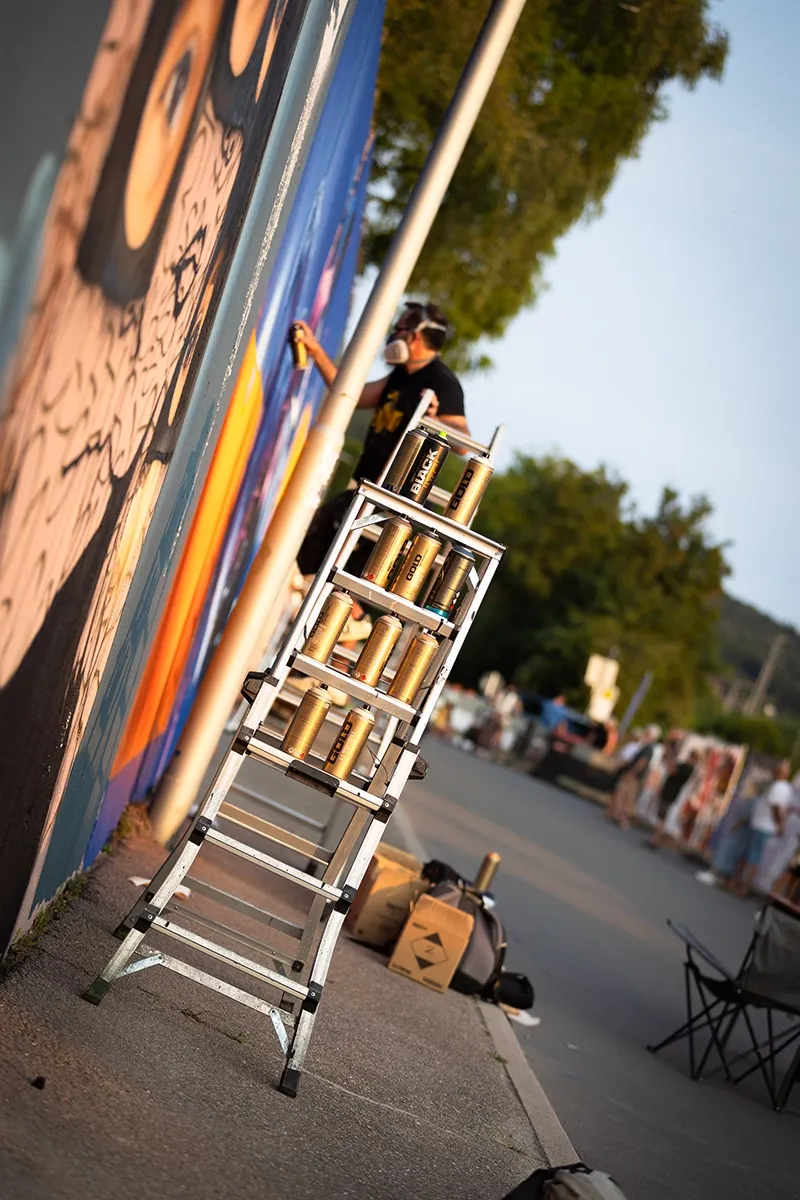
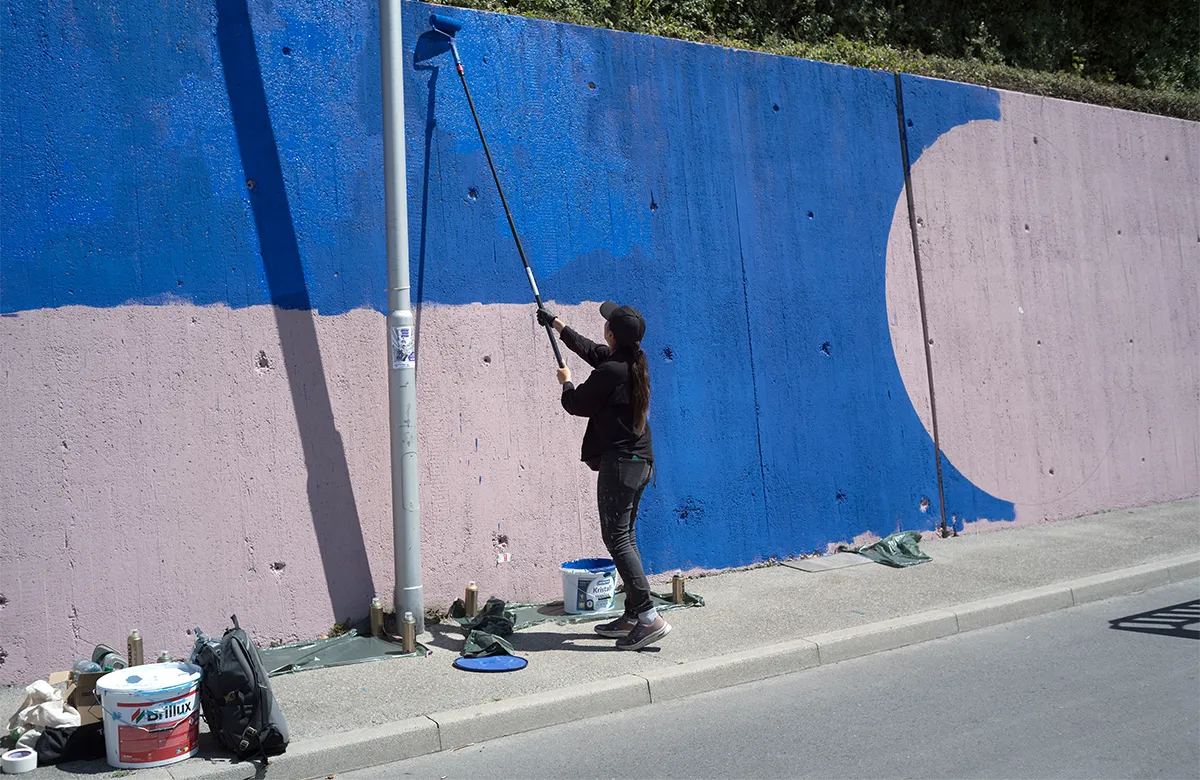
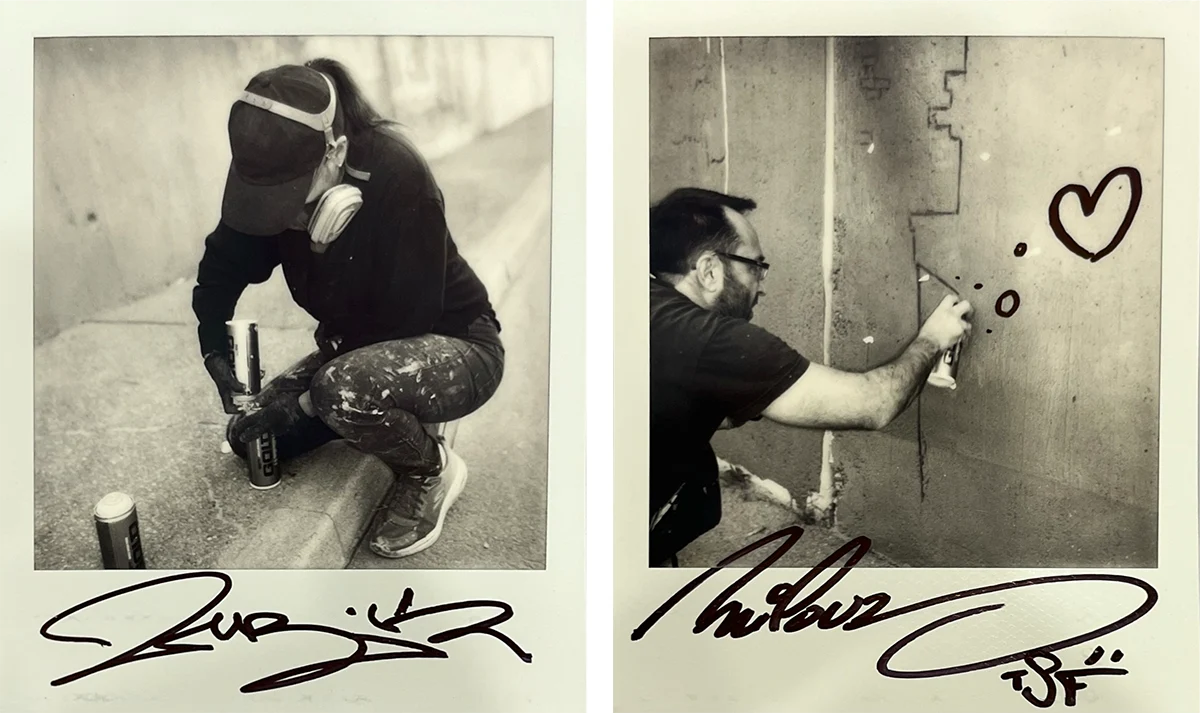
These are some of the images taken during the process; photographer credits are at the bottom of each one.
Special thanks to the festival organizers Clara Fosca and Janis, for their commitment and dedication to bringing a piece of Graffiti to the city of Mosbach.